Showing posts with label mall. Show all posts

Thursday, July 7, 2022

Trexler Mall (Trexlertown, PA)

Sometimes when looking into malls that no longer exist, you find one that never really seemed able to catch a break; sometimes you find a mall that never did better than "okay" at any point in their years or even decades of existence. The Trexler Mall was one such mall. With a combination of bad decisions and bad luck, it never quite made it. Still, it did exist for almost 30 years. Here's the story:

Or The Shoppes at Trexler, as the site is now known

The Trexler Mall was conceived of and built by the Hanover Co., a small-time mall developer that had drawn up plans to build a few other malls as well, but I'm not aware of any others that Hanover actually completed. Anchor tenants were Laneco, Grant City, and A&P. Laneco was a regional chain of what you might call proto-hypermarkets. They started off as grocery stores but later expanded into general merchandise. Many Laneco stores featured both department store and grocery store goods under one roof, but some only had one or the other; the Trexler Mall location, from what I can tell, was only a department store and didn't have a grocery section. Grant City, meanwhile, was the large-format discount store division of national dime store chain W.T. Grant. Grant City was sort of like Grant's answer to S.S. Kresge's then-popular Kmart concept. A&P was an American supermarket chain that requires little introduction. In the early 70's, it was apparently a trendy practice in commercial real estate to have enclosed shopping malls that also featured a strip mall component; accordingly, the Trexler Mall was only truly a mall in a straight line from Laneco at one end to Grant City at the other end. A strip of stores then jutted out at an irregular angle from the side of Grant City leading on down to A&P.

Aerial view of the Trexler Mall. On the left side was A&P; on the right side was Laneco; and in the middle at the elbow area was Grant City.

The Trexler Mall opened on November 1st, 1974, following close on the heels of the Palmer Park Mall and the Westgate Mall (both opening in the latter half of 1973). The Trexler Mall was to serve the nascent western suburbs of Allentown, though some commentators have noted that these suburbs had not yet developed enough by 1974 to adequately support a regional shopping mall. Upon opening, the mall had roughly half of its spaces occupied. That might sound underwhelming, but it's actually historically common for malls to open in that condition. Often times the other spaces may have prospective tenants lined up but not ready to open until months after the grand opening of the mall, and it was likely the same case at the Trexler Mall. 

Two years after opening, the Trexler Mall was in a lot of trouble. Wooden paneling covered vacant storefronts in the mall much like how drywall panels are used in the malls of today.

However, shortly after opening, the Hanover Co. that developed and owned the mall went bankrupt. By 1976, Hanover Co. had ceased to exist, and a mess of corporate entities had formed and dissolved in its wake. The courts were bogged down trying to determine who exactly even owned the Trexler Mall. Meanwhile, no new tenants could take residence in the mall for the duration of this legal question being unanswered. Making matters all the worse was the bankruptcy of the W.T. Grant Company. Grant's bankruptcy was then the 2nd largest bankruptcy filing in US history, and resulted in total liquidation of the company. Grant City going dark further hurt foot traffic to the mall and left shop owners desperate for a turnaround.

A perfectly preserved Grant City storefront at the Trexler Mall seen in 2019. The water tower behind it used to say "Trexler Mall" before being repainted around 2017. Grant City facades looked like this and a few examples have persisted since 1976 when companies like Kmart took over the stores and did little to alter the look. This particular Grant City facade remained largely undisturbed despite operating for decades as Hess's and then The Bon-Ton department stores. It has since been destroyed when Urban Air Adventure Park moved in.

In 1977, things finally began to improve. The legal issues were resolved, and the banks foreclosed upon the mall. Montgomery Development Co., which had a hand in developing several other malls in the Lehigh Valley, was appointed to manage the Trexler Mall. And Grant City was replaced by Hess's department store of Allentown. The mall was able to crawl out of financial ruin and sustain itself financially under new management.

Trexler Mall, 1985. Get a load of that mirrored skylight! Note Hess's occupying the former Grant City anchor building and RadioShack in the background.

In 1985, businesses in the mall complained about lost sales due to a weeks-long strike by Laneco workers. Particularly, businesses nearby to Laneco in the mall reported a sharp drop in foot traffic. Eventually the strike lifted and life went on. In 1988, A&P rebranded their grocery store at the mall as a SuperFresh supermarket. It was in the 90s that the mall started to really struggle again, starting in 1993 with the closure of SuperFresh. A&P cited "extremely poor sales" at the SuperFresh justifying the closure. These bad sales were attributed to competition from a new, larger Redner's Warehouse Market that had opened down the street in 1990. In 1994, Hess's department store was sold to The Bon-Ton Stores, Inc. due to Hess's having poor sales and high debts. The store was rebranded as The Bon-Ton and remained open at the Trexler Mall. In 1995, Giant Supermarkets signed a lease to redevelop the old A&P/SuperFresh and open a large Giant supermarket on the site. However, that same year Laneco shut down their store, leaving another major vacancy at the mall. That year, the Morning Call newspaper ran an article titled "Time is the Enemy for Ailing Trexler Mall" in which writer Allison Salerno opined that "actual shoppers are hard to find" in the mall. An unnamed employee at the mall stated for the press, "I've seen the demise of this mall... I've lived in the area for 20 years." The former Laneco was used for flea markets while a permanent tenant was searched for, but no such permanent tenant was found.

Under new ownership, the Trexler Mall was pushed along the path of redevlopment and de-malling.

At some point, the Trexler mall was acquired by Cedar Realty Trust, which appointed TKO Real Estate Advisory and RD Management to lease and manage the mall. Cedar and its management companies immediately began making moves to reposition the mall for alternative uses. A lease was signed with the Lehigh Valley Health Network to open a health center in the former Laneco in 1998, marking the first major deviation for the mall away from traditional retail use. Then, in 1999, mall management terminated the lease of The Bargain Cinemas to make way for a new fitness center. Speaking to the news, Ted Kraus of TKO & RD Management said of the movie theater, "they were a good tenant, especially unique with their value pricing. They were willing to stay, but they were not going to be an asset to the new center. We're going through the process of de-malling the mall." The Trexlertown Fitness Club opened in January 2000, taking over not only the old cinema but also the entire main entrance to the mall next to The Bon-Ton.

The Health Center at Trexlertown, part of the Lehigh Valley Health Network, opened in the former Laneco at the Trexler Mall. This was the beginning of the end for the mall.

If the Health Center at Trexlertown was the beginning of the end for the mall, Kohl's was the end of the end. In 2002, mall ownership petitioned for several zoning variances from the local government to redevelop what remained of the mall interior in order to let a new Kohl's department store open up in the middle of the mall in between the Health Center and the Fitness Club. Over the course of the next year, approval was gained and the mall interior was permanently closed to allow Kohl's to take over the whole space, making the transition from an enclosed mall into a strictly open-air retail center complete. And unlike the Whitehall Mall and Richland Mall, which ultimately did not prosper after being de-malled, the Trexler Mall has actually performed consistently well as a strip mall, with vacancies tending not to last very long. When Giant Supermarkets departed the Shoppes at Trexler in 2011, their store was redeveloped and is now a Marshalls / HomeGoods. When The Bon-Ton went bankrupt in 2018, their store at the Trexler Mall was among 42 stores nationwide that were set to close as Bon-Ton unsuccessfully attempted to turn the company around. After closing, the store was repurposed as an Urban Air trampoline park. It's distasteful how the mall owners went about creating the "Shoppes at Trexler," particularly by evicting tenants in good standing like the movie theater because it didn't fit their vision for the property. But ultimately, after a lifetime of hardship, maybe there was just no saving the old Trexler Mall and redevelopment was an inevitability. Either way, what's done is done now. That's a wrap for this mall; thank you for reading.

What was once a tiny A&P and later a large Giant supermarket is now a Marshalls / HomeGoods combination store.

Another angle of the former Grant City. Bon-Ton selected this store to close even before the company was doomed to go out of business entirely. I heard speculation that Bon-Ton's sales at this location suffered due to it being sandwiched in between rival department stores Kohl's and Marshalls.


Saturday, February 5, 2022

Westgate Mall (Bethlehem, Pennsylvania)

The Westgate Mall in Bethlehem is a sleepy community mall from the 70's with a size of just 270,000 square feet of leasable space. As Bethlehem's only (surviving) mall, it was once a prominent shopping center but has since become a serial underperformer. As a result, the mall is probably doomed; the city knows they could be making more tax revenue off of that prime real estate if the mall gets torn down and redeveloped, and the mall owner seems more than happy to play ball. Admitting this brings me no joy, since this is my favorite mall, and I've been going here all my life. But for now, the Westgate Mall remains open for business, and I feel it is long overdue for me to do a writeup for this beautiful little place.
This Westgate Mall pylon advertises Hallmark and Payless - both of which left the mall in 2019.
Harold S. Campbell was a maverick developer in Bethlehem, who was known as a bull-headed but shrewd businessman. Born May 5th, 1913, Harold began his career as a milkman during World War 2. He began building houses after the war and would end up developing a great many of the houses and even entire neighborhoods in and around the city of Bethlehem. Campbell became infamous for his battles against city planners who he saw as standing in the way of his developments. In a cartoonish "rich business guy" style, he even had a pair of German Shepherds that he named Gold and Silver. Some of his other notable projects included founding the Westgate Water Company and supplying land for the development of the Lehigh Valley Hospital-Muhlenburg and Martin Tower. But his most prized development of all would come, at first, in the form of a modest strip mall in Bethlehem called the Westgate Shopping Center, so named due to its location on the western fringe of Bethlehem. The first store was supposedly 7-11, opening in 1964. The shopping center also housed tenants such as George's IGA Foodliner, Thrift Drug (which was at the time a subsidiary of JCPenney), and a local tavern called The Beef House.
Approximation of the Westgate Shopping Center after the 1967 opening of George's IGA food market at the center. The border around the image denotes the parcel of land that the whole mall would eventually occupy.

But the whole retail landscape changed when, in 1966, the Whitehall Mall opened its doors as the first enclosed shopping mall in the Lehigh Valley. At this point, few in the Lehigh Valley had even heard of a mall, making the Whitehall Mall an exciting new experience - and a smashing success story that would attract the attention of competitors. A number of developers started raving to get in on the action. These included Morris Kravitz of Kravco; Frank Pasquerilla of Crown American Corporation; and Phillip Berman of Hess's Department Stores. Harold Campbell was just as eager as any of them to build his own mall, so he resolved to expand his Westgate Shopping Center into a mall as well. He negotiated for Hess's Department Store of Allentown to open its first ever satellite location on his property to serve as the senior anchor tenant for the mall. This process was not without a hitch, though; both parties wanted to own the land that the department store would be built on. Hess's business strategy at the time involved the chain owning rather than leasing all of its department stores, while the famously stubborn Campbell was quite insistent upon keeping the mall all together on one property, under his ownership. As a compromise, the two sides agreed that Campbell would own the land from the start, but that at the conclusion of a 30 year lease, Hess's would have the option to buy the land for $500,000. This agreement, which did not account for inflation, would end up becoming awkward down the line - more on that later. Hess's Westgate, as the department store was called, opened at the site in 1971. Then, construction began on the mall itself, to be built spanning the gap between the original strip mall and the new Hess's store.
A recreation of what the Hess's Westgate signage would have looked like. This was the style of early Hess's stores which had names specific to each location, such as Hess's Westgate, Hess's North, Hess's South, Hess's Palmer Park, etc. The "Westgate" part of the store name was still mounted on the building until 2021.

The mall originally used this Germanic script for its signage. Today, this solitary enter/exit sign is the last remnant of that era. It is right next to a newer enter/exit sign, but for some reason nobody has ever taken this old one down.
Grand opening of the mall, with guest appearance from Democratic US Representative Fred Rooney, who represented the local congressional district from 1963 to 1979. Note Bill Hawk's Music Center on the right; this store remained in that same spot until 2015 when it moved to the opposite end of the mall, where it continued to do business until being evicted in 2023.

Celebrating its grand opening October 4th, 1973, the shopping center now dubbed the Westgate Mall attracted crowds of shoppers. Some of the earliest tenants in the mall, in addition to those which already occupied the original strip mall, included Westgate Optical, Hourglass Hallmark, Bill Hawk Music Center, Westgate Beverage, Westgate Jewelers, McCrory's, Westgate Pizza, Hickory Farms, Eugene Jacobs menswear shop, Kay Jewelers, RadioShack, Bookarama, Ladybug, Family Pet Shop, and a trio of related stores called Fashion Colony, Junior Colony, and Colony III. The mall had just two outparcels: a freestanding Hess's Auto Center and a Dempsey's American Kitchen restaurant. Hess's itself measured nearly 109,000 square feet, and the mall reportedly had about 50 stores upon completion.


George's IGA Foodliner at Westgate Mall. (Morning Call file photo)


Nice car. Morning Call file photo shows the Westgate Mall in its heyday. Note that tenants on the parking lot-facing side of the mall had exterior entrances as well as interior ones. Next to the main entrance is Hickory Farms, followed by Fashion Colony, Junior Colony, and Colony III. I can't make out the names of the tenants further down the line.
Lanta Bus once ran a promotion where shoppers could ride free of charge to and from the mall provided they made a certain minimum purchase at participating stores. Note McCrory's on the left hand side of the main entrance.

Approximate floor plan of the original mall, with anchors and known junior anchors labeled. Inline units are estimated. The existing strip mall had an enclosed walkway added along the front of the stores, which then wrapped around the McCrory's store to become a more traditional enclosed mall with stores on both sides of the hallway as it led down to Hess's. The mall had two different 2nd-story sections - I'm not 100% sure, but I think it was always just offices up there.

The Westgate Mall's tenant mix casted a wide net, in typical fashion for malls of its age, by featuring a beloved local department store, supermarket, drug store, and dime store. It was atypical only in that it featured just one department store. Most developers would have tried to land a major, national department store like Sears, JCPenney, or Montgomery Ward to add onto the mall's offerings. But the confines of the parcel of land the mall sat on likely prevented any thought of devoting another hundred thousand square feet to another anchor. Although small, the Westgate Mall found success as a shopping mall offering a little bit of everything that Bethlehem could call its own. However, within its first five years, the mall would face tragedy. On the morning of February 12th, 1977, patrolmen John Haslego and Richard Heffernan responded to a robbery that tripped the burglar alarms at Kay Jewelers in the mall at 1:07 AM. As they arrived, they saw a fire raging through the roof of the mall. All of Bethlehem's 7 fire engine companies, 50 firefighters, and 3 aircraft responded to the blaze. A fire wall saved Hess's from the worst of the damage, but the flames overran two fire walls in the opposite direction as they spread southbound through the mall itself. The inferno raged through most of the night, injuring six firefighters and destroying 18 shops. All told, it was estimated to cause a $16 million loss and went down in history as the second worst fire to strike Bethlehem. The fire was ruled an arson.
Morning Call file photo shows the devastation brought on by the 1977 Westgate Mall fire.
The stores that were destroyed in the fire were Ladybug, Cargo West, Endicott Johnson Shoes, Pick-A-Dilly Restaurant, Pick-A-Dilly Snack Bar, Eugene Jacobs, Richmond & Reed Shoes, Alice Kay, Clymer's Carousel, Colony III, RadioShack, Holiday Hair, Family Pet Shop, Kinaman's House of Music, Kay Jewelers, Variety Photo, Bookarama, and Record City. Even more stores suffered smoke and water damage, including Hess's, McCrory's, Feel-Fine Shops, Bill Hawk Music Center, Junior Colony, and Hickory Farms. But though the mall was largely destroyed, it was not destined to die young. The mall and its tenants rebuilt once more and prospered. With pride on the line, Harold S. Campbell had the mall rebuilt double-time for a grand-reopening in August of the same year, just six months after the incident. Stores, many of which had reopened even sooner, reported good business and a return of old customers in no time. 
The incredible vintage all-wooden storefront for what was originally Eugene Jacobs men's store. After the fire, Eugene Jacobs rebuilt their expanded store in this spot. Due to mergers, Eugene Jacobs later became The Hub and finally Jack Lang, all menswear stores. The most recent long-term tenant here was the Art & Drafting Connection, which did business for almost 20 years here after Jack Lang closed.
Once the 90's came around, change was in the air. Some of those stalwart tenants that made the Westgate Mall their home for decades were impacted by the economic recession, and not all of them made it. The Jack Lang men's store advertised that it was going out of business in local newspapers in March of 1991. Junior Colony, which was based locally in Allentown and had 114 stores under several different brand names at the beginning of 1991, filed for chapter 11 bankruptcy protection in September that same year. They emerged from bankruptcy the following year, before ultimately closing down in 1994. Fashion Colony - Junior Colony's plus-size division - may have survived a bit longer, however, as that brand was sold off to separate ownership in 1993. The anchor tenants shuffled around a bit as well - George's IGA was bought out and became part of the King's IGA family of stores in 1992. King's, in turn, was bought by Weis Markets two years later. Hess's had been struggling due to overexpansion, and in 1994 most of its remaining stores were sold to The Bon-Ton. Thrift Drug, a subsidiary of JCPenney, became Eckerd drugs in 1997 after JCPenney bought that brand as well and consolidated the two chains. At some point along the line, McCrory's rebranded their store at the Westgate Mall under the J.J. Newberry five-and-dime brand name. 
The Bon-Ton bought all of the Lehigh Valley area locations of Hess's department store in 1994. Hess's parent company, Crown American Corporation, had been selling the chain off to various rival department store chains in the 90's due to Hess's poor sales and a high debt load. Bon-Ton didn't do much to change the exterior facades of the former Hess's stores they bought. In fact, this location was virtually untouched until late 2017 when Bon-Ton renovated the entranceway and updated their signage - apparently not anticipating going bankrupt just a few months later. 

Early Hess's locations often featured standalone auto centers, but these were discontinued after Hess's was bought by Crown American Corporation. New Hess's stores built after that point did not include auto centers. At some point Jack Williams cut a deal to sublease these old auto centers from Hess's/Bon-Ton. You might notice that the Jack Williams has cobblestone panels above its windows that match the exterior facade of the old Hess's department store.

George's IGA borrowed some exterior design elements from A&P. George's moved into the shopping center in 1967 and expanded in 1971 as the mall was being built. Interestingly, the store was observed to have differing ceiling heights due to the gradual expansion of the store over time into neighboring vacant spaces in the mall.
The changes in retail brought on by the 90s had longstanding impacts on the mall scene of the Lehigh Valley. The Whitehall Mall, whose success inspired the construction of the Westgate Mall in the first place, was mostly demolished in 1998. It was, perhaps, an ominous sign of what would come for Westgate, too, some day. Although the mall managed to snag the coveted "westgatemall.com" web address (there's so many Westgate Malls out there that this is genuinely impressive) which proudly displayed the slogan "It's Going On... At Westgate Mall!", vacancies began to become a consistent problem. The first big casualty was the J.J. Newberry. As a division of McCrory Stores, Newberry's outlived other big dime store chains like Woolworth. But towards the end of its lifespan, McCrory Stores accepted the reality that the five-and-dime concept was on the way out, and it began thinking of ways to alter its business model. McCrory experimented with a dollar store concept called Dollar Zone, selling cheaper products. The J.J. Newberry at Westgate Mall was transformed into a Dollar Zone in the year 2000, but it was a botched transition. The Newberry sign still hung above the storefront while paper Dollar Zone signs were printed and hung up around the inside of the store. The old-school lunch counter remained in operation in the store - a remnant of the past that seemed so out of place in the new business strategy that McCrory Stores was pursuing. Shoppers rebelled at the Dollar Zone concept, balking at the cheap imported products it peddled. The frankenstore shut down at the bitter end in 2001, when McCrory Stores liquidated all of their remaining stores - most of which, by that point, had been converted to Dollar Zone in the unsuccessful attempt to save the company. The Newberry's junior anchor spot would later be occupied by an off-brand dollar store or two, but mostly stayed vacant.

In October 1999, the Crown American Realty Trust announced their intention to purchase the parcel of land that housed The Bon-Ton department store. As per the agreement made between Hess's and mall owner Harold Campbell in 1970, Hess's had the option to purchase the land for $500,000 at the conclusion of a 30 year lease. The lease fell into Crown American's hands due to Crown having purchased the Hess's department store chain in 1979. By this point, the land value had increased dramatically. Crown American disclosed in its 1996 annual report that it received a revenue of $369,000 from subleasing the anchor pad to Bon-Ton in that year alone. Suffice it to say, purchasing the land outright for just $500,000 would have been a steal - roughly 10% of the actual value of the property. The mall's ownership litigated the issue in court, arguing that the purchase option was only available to Hess's - an entity which no longer existed. The legal battle would last for years.

Meanwhile, Campbell himself was in advanced age and declining health. He and his family ended up in a separate legal battle for control of the mall itself in 2002. Campbell had given power of attorney to his mall managers, Mylee Snyder and Helen Cline, in 1997. Snyder and Cline had worked for Campbell at the mall since the 80's, and used their power-of-attorney to assume mall operations starting that year. Campbell then instead granted power-of-attorney to his children, Dr. Harold S. Campbell Jr. and Joanne Burke in 2002. The pair of Campbell's kids appeared at the mall office on Tuesday, June 4th, 2002, armed with the new power-of-attorney and "claiming the right to exercise immediate control of the Westgate Mall and all of Mr. Harold S. Campbell Sr.'s personal and business affairs." Campbell Jr. & Burke converged on the management office with their own attorney and armed security and attempted what the local news described as a "coup" against Snyder & Cline that ultimately turned physical. In the wake of the incident, the management office at Westgate Mall was said to be locked & guarded. The issue was brought into court, where Campbell himself appeared at age 89 behind a walker. The still-imposing and fiery 6'1 Campbell immediately attempted to dismiss attorney Charles Bruno, who was hired by Cline & Snyder in 1997 to represent Campbell's estate. Reportedly, Bruno whispered to Campbell, "May I have a private word with you, Mr. Campbell? I represent you," to which Campbell retorted, "No you don't, and you never did. You ought to know that by now." Both sides accused the other of trying to take advantage of a wealthy old man, with Campbell's children further accusing Cline & Snyder of selling off nearly $1.3 million of Campbell's real estate properties & $100,000 in securities without consulting him. Ultimately, a judge ruled in 2003 that Campbell was no longer competent to fire the attorney that supposedly represented him or to strip Cline & Snyder of their power-of-attorney.

Morning Call file photo captures the Westgate Mall in 2002 - past its prime but still looking good. On the left side of the hallway is The Toy Tunnel, and just next door with the comically large gumball machine is the Candy Karousel. On the right side of the hall is a store called Real Style.
On January 23rd, 2004, Harold S. Campbell Sr. died at the age of 90 while in the midst of these legal battles. It was unclear, according to local news, how his death would affect the ongoing fight for control of his assets. Presumably though, Campbell's estate was left to his kids in his will, allowing them make whatever decisions they wanted in terms of managing the mall. When the dust settled, the mall ended up in the control of the Harold S. Campbell Foundation, a charitable group founded by the late developer's family. But they had little time to celebrate before a judge rejected their final appeal in 2005 to prevent the sale of the anchor pad housing The Bon-Ton department store for just $500,000 to the Pennsylvania Real Estate Investment Trust (a.k.a. PREIT, who bought Crown American out in 2003). With this outcome, the mall would no longer collect hundreds of thousands of dollars per year in rent from its largest tenant. Fortunes continued to decline as a new shopping complex, Airport Center, opened just a 7 minute drive away from the Westgate Mall in 2010. Featuring big name stores like Target, Sam's Club, Ross, A.C. Moore, Five Below, Old Navy, DSW, and Ulta Beauty, Airport Center had a clear competitive advantage over the collection of local shops that were camped up in the Westgate Mall. Within a few years, even the old Kay Jewelers, which had stuck around all those years even after being robbed & burned back in '77, left the mall to join Airport Center. By 2013 the Harold S. Campbell Foundation sold the mall to local developer Mark Pepitone for the scant price of just $2.3 million. After the sale, the Campbell Foundation ceased to exist, and family control of the 40 year old enclosed mall finally ended. Pepitone separately purchased the anchor pad housing Bon-Ton from PREIT for $3.85 million, reuniting the mall once again. He began a renovation with a $5 million budget aimed at revitalizing the mall.
George W. uploaded this image to FourSquare in 2013. It stands in a rather stark contrast to the previous picture, taken at a similar angle about a decade prior. The store way on the left was Westgate Optical, which moved out of the mall but seems to still do business today. The now-closed Toy Tunnel, Candy Karousel, and Real Style storefronts are also plainly visible. Mall plants previously seen in the hall have disappeared. The Bon-Ton is brightly illuminated at the far end of the otherwise empty hallway.

Map showing the occupancy of the Westgate Mall around the time that Mark Pepitone bought it in 2013. Red spaces are vacant. At this point the upstairs section above the old McCrory's was totally closed.

The abandoned Dempsey's American Kitchen outparcel at Westgate Mall. Opened with the mall & closed in 2005. Dempsey's was at one point a local chain of over a dozen restaurants based out of Reading, PA that I think I'll write a separate blog post for some day. This was the 2nd-to-last location left in the chain when it closed. The last one closed in '08 I think. People have commented that this looks like a Howard Johnson with the red roof and cupola. It's possible that Dempsey's took some inspiration from HoJo's when building this restaurant. Dempsey's was finally demolished in the fall of 2023.

The wooden Dempsey's sign, still plainly readable.

A peek in the front door of Dempsey's.

A peek in the back door of Dempsey's.

Me eating Subway inside the mall in the summer of 2019. The restaurants inside the mall all seem to do pretty well. Westgate Jewelers, a very early tenant, is seen open across the hall.

Pepitone's renovation began in 2015. The centerpiece of this project was adding a SkyZone trampoline park to the center of the mall. SkyZone filled a lot of space, including the old McCrory's, Westgate Optical, Toy Tunnel, and Candy Karousel, and even extended out into what had been the mall's main entrance corridor. As a result, the corridor had to be re-routed around the new anchor tenant. This much was accomplished & was a huge success that gave the mall a new lease on life. The exterior of the mall, in some places, was updated with a new facade to make it look newer and more appealing from the street. The plan also involved converting the part of the mall between Rite Aid and Weis back into a strip mall, as it originally had been, by removing the enclosed hallway from the front of the building. Work began on this venture, and the hallway was indeed ripped out from in front of Rite Aid and a handful of other tenants, but stalled out before it was completed. Other goals that Pepitone had included redeveloping the old Dempsey's Diner, but this too did not occur. Eventually 2018 came around, and The Bon-Ton Stores, Inc. had filed for bankruptcy protection. In April that same year, it became clear that Bon-Ton would face total liquidation. Mark Pepitone was now in possession of two local malls (the other being Easton's Palmer Park Mall) that were set to lose an anchor tenant. He chose to hang onto Palmer Park Mall, the property which objectively had the better future prospects, while opting to sell Westgate Mall at a profit to Onyx Equities, a Woodbridge, NJ firm for a cool $30 million - almost 5x what Pepitone had paid for it 5 years prior.
One of the mall entrances. This is the exterior refresh that Mark Pepitone's renovation brought in. It's less crusty looking than the old brick facade from the 70's that came before it, but on the other hand it's kind of a generic modern commercial design that doesn't even have the name of the mall on it.

In front of the Rite Aid where it got de-malled. This sidewalk tells quite a story: you can see the lines on it from when the enclosed mall hallway was built directly on top of it in the 70's. Now that this part of the mall has been removed, the old sidewalk from the 60's has been revealed again.

A closed Bon-Ton at the far end of Westgate Mall. Bon-Ton occupied over 100,000 square feet and even expanded into 2 inline spaces of the mall to house their furniture & bedding galleries (seen on the right). The vacant tenant on the left used to be the Westgate Family Fun Center, which was a cheesy arcade.

Occupancy of the Westgate Mall towards the end of 2018 after Onyx took over. Note the mall no longer connects all the way over to Rite Aid, and the addition of SkyZone.
After the sale, Onyx remained very private about their plans for the mall. The first big news came in November 2019, when it was revealed that Weis would move out of its old central location in the mall and instead take up residence in about 2/3rds of the former Bon-Ton. The new Weis would be a much larger, state-of-the-art supermarket complete with liquor sales and a new gas station in the parking lot. This plan was, of course, delayed by the outbreak of a global pandemic about 4 months after the announcement. Though, interestingly, not a single tenant inside the mall closed permanently during the pandemic to date. Rite Aid ended up closing in 2021, but that's all. Weis proceeded with the plans after a modest delay, opening the new supermarket in 2021 instead of 2020. Progress on leasing was made elsewhere too, with a bank signing a lease to redevelop the former Dempsey's Diner; Harbor Freight signing on to open in a portion of the old Weis supermarket; Lehigh Valley Health Network signing a lease for 27,000 square feet in the rear of the former Bon-Ton as a medical equipment processing facility; a proposal to add a McDonald's to an undeveloped part of the mall parking lot; and negotiations underway with an unnamed "general medical facility" to camp up in the now-closed Rite Aid spot. It was good news all-around that is currently serving to fill up the mall's most glaring vacancies. Unfortunately, unlike predecessor Mark Pepitone, Onyx isn't in the business of bringing the Westgate Mall back to life; Onyx Equities is in the business of destroying the mall. As Matt Flath of Onyx explained, "You have the old interior mall that is between where the new Weis is and where the old Weis used to be, and we have a few different ideas as to how we're going to redevelop that part of the center, which we'll be announcing over the next probably six months. So, we definitely realize that model for that old, small interior mall layout is dated and doesn't work."
This is the current redevelopment proposal posted in Metro Commercial's digital pamphlet for the mall. It's got everything that the world doesn't need more of: a bank, a McDonald's, and a former mall turned into a completely unremarkable strip of box stores


The new Weis under construction. The Bon-Ton sign lives on at the former furniture gallery.

It was an ominous sign when Weis finished construction, and still the old Bon-Ton mall entrance remained sealed. I had really hoped that Weis & Onyx would take inspiration from a new trend of grocery stores opening up as mall anchors by keeping an entrance for Weis inside the actual mall. This practice was common in the 70's but fell out of favor since then - only recently making a comeback. Locally, the Stroud Mall in Stroudsburg successfully redeveloped a former Bon-Ton to accommodate a new Shop Rite, which opens up straight into the mall.
 As of 2022, the mall is still open and probably will be for a little while. There's a lot of logistics & red tape to cut through when dealing with the remaining tenants that are only accessible from inside the mall (which notably includes SkyZone) but Onyx has a stated goal of moving as many tenants as possible to exterior-facing units by 2023. That being said, if you want to see this mall I'd recommend doing it soon. A portion of the mall in front of the old Weis is now closed off as of December 9th 2021 for construction related to Harbor Freight moving in, and it may not ever reopen.
Current map (early 2022). Note the stretch of mall that's now closed to the public. The state liquor store is the only tenant keeping that one part of the mall on the left side of the map open.


The Westgate Mall sign being torn down, August 2021

I was surprised to see this when I turned the corner

The old Weis behind construction fences. "Welcome"

This part of the mall only serviced the liquor store when this photo was taken. The liquor store has since moved to temporary digs elsewhere on the property to facilitate the de-malling of this section.

Looking down the hallway. The liquor store is on the right close to the far end. The empty unit farthest from me at the end of the hall was Hourglass Hallmark. The two tenants on the left side were ABE vacuum & sewing machine repairs and Country Rose Florist. The unit with address 2293 on the right was a Curves gym and later The Spa at Westgate. The unit on the right just next to it was Westgate Daycare.

Former Westgate Daycare, which extended up onto the 2nd floor level as well. This part of the mall has kind of an old-timey main street sort of theme with those old decorative lanterns and faux roofs over many of the storefronts.

This section of the mall has had leaking roof problems

The closed doors up ahead are locked, sectioning off the stretch of hallway that dead-ends on the other side of that plywood barrier I showed you before. On the left was Curves gym / the Spa at Westgate. Right in front of me was a store called The Camera Shop, which at some point became part of Ritz Camera & Image. See again the faux streetscape theme with this storefront. On the right side was ABE sewing & vacuum.

Looking down the closed off hallway. That case built into the wall on the left says Westgate Mall at the top and holds trinkets from the different tenants inside, all likely destroyed now.

Back in the main stretch of the mall. I just think it's such a beautiful place. You have to think that they could improve the profitability of the mall while still keeping a piece of the interior preserved, but I guess that would require Onyx to have an original thought, or to do something that requires a little bit of effort. Too much to ask.
That's about all I can say about the Westgate Mall for now. Highly recommended additional reading on this mall can be found at this blog post which includes 2012 & 2014 pictures that show The Bon-Ton when it was open & prior to its exterior getting renovated, when it still looked exactly as it did in 1971. The pictures also show the mall before the layout was altered to accommodate SkyZone and before Mark Pepitone's exterior renovation of the mall. Also check out this blog post about the Westgate Family Fun Center, with plenty of pictures. I clearly remember the weird "A Prize Every Time" game with the chicken in it. Although I caution readers that there are a few pictures there purportedly from the Westgate Mall which are in fact rather from the Whitehall Mall.

UPDATE: 4/7/23

As I write this, the day is April 4th, 2023, and it is the last day of operation for Subway at the mall. It is one of a number of tenants being evicted to clear the way for demolition of a section of the mall. The other affected tenants, Hawk Music (since 1973), Holiday Hair (since the 70s), Westgate Jewelers (since the 70s), Amateur Athlete Skateshop (Since the 80s), More, and Fashion Nails have all already closed or found a new home at some other shopping center whose owners have an ounce of respect for their tenants. What else is there to say?

Sunday, June 28, 2020

Whitehall Mall (Whitehall, PA)

This one is a downright tragedy. The Whitehall Mall is a primarily outdoor shopping center located on the bustling retail corridor of MacArthur Road in Whitehall Township (just outside of Allentown). Buried in the Whitehall Mall is a single, small interior corridor with but a few low-end local shops camped inside. It is a tremendous fall from grace for what was, at one time, the beating heart of commerce in the Lehigh Valley. Read on for the story of the rise and fall of the Whitehall Mall.
Whitehall Mall pylon sign in 2019.
Philadelphia-based real estate developer Donnelly & Suess, Incorporated was responsible for the construction of the Whitehall Mall. Founded in 1897, Donnelly & Suess had done some noteworthy work in the Philadelphia area and other parts of eastern Pennsylvania, including housing projects on East Mt. Airy Avenue in Philadelphia in the early 1900's. The mall, however, would be the company's largest and most ambitious project.
The former offices of Donnelly & Suess, Inc. still stands. Above the door at the right-hand side of this building, the address "931" is carved. 931 Lehigh Avenue in Philly was the Donnelly & Suess HQ as early as 1915. Image from Google Street View.
In January of 1963, Donnelly & Suess announced their intention to build a mall in rural Whitehall Township along a sleepy stretch of road through the farmlands. At that time, few people in the Lehigh Valley had ever heard of a mall before. It would be the first enclosed shopping mall built in eastern PA, outside of the immediate Philadelphia area. It was a radical idea that sought to bring everything you could ever need under one roof - shops, offices, department stores, a food market and even a cinema. By 1965, the red tape was cut through and ground was broken for the first time on the project. For the symbolic ground-breaking photo-op, a unique five-handled shovel was used. Holding the shovel were Leonard Mercer, the vice president of Donnelly & Suess; Donald Vollmer, president of the Zollinger-Harned department store company; Charles A. Raab, general manager of Sears, Roebuck, & Company in the Lehigh Valley; Whitehall Township commissioners President Arthur Wieand; and Allentown Mayor F. Willard Harper. From a plot of farmland that had been bought for a mere $125,000, a titan of commerce was about to rise.
Ground is broken at the Whitehall Mall. To the far right is Harry Greenberg, a representative of the mall developer, Donnelly & Seuss, Inc. Donnelly & Suess would later become Greenberg Realty Associates, and Harry Greenberg would go on to develop a number of clubs and discotheques in Allentown and Philadelphia, while also continuing to own and manage the Whitehall Mall.


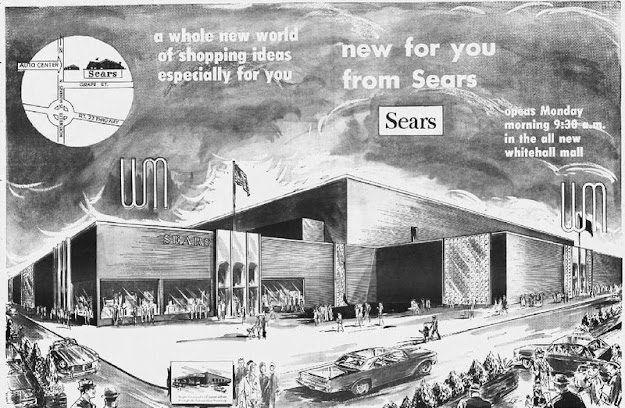
This file photo from The Morning Call shows downtown Allentown's Sears store. The Whitehall Mall lured Sears to close this store and open a newer, larger store at the mall. The hulking Sears store would be the main anchor of the Whitehall Mall.
Ad for the new Sears department store opening at the Whitehall Mall
Comparison photo of the Sears in 2019. Notice the brick is off-color where they bricked over the old display windows.
Whitehall Mall under construction. Photo credit: macarthurroad75.com

Zollinger-Harned, a local Allentown-based department store, was the first to open its doors at the mall on August 15th, 1966. The event drew some 25,000 shoppers and caused traffic jams at various times of the day. The rest of the mall opened on September 26th, 1966. Ownership was split 50/50 between Donnelly & Seuss (the developer) and Pennsylvania Real Estate Investment Trust (PREIT). This was just the first of several malls PREIT would become an early partner in. Reporters raved about the mall amenities, including cascading fountains and lush plant life in planters whose design was inspired by the 1958 World's Fair in Brussels, Belgium. Aside from Zollinger and Sears, the mall was originally anchored by an especially large (~44,000 square feet) Woolworth five and dime store and a Weis Food Market. Other noteworthy tenants included the Plaza cinema and Percy Brown's Cafeteria. All told, the mall included 52 shops under its roof. The mall was primarily single-story, though there was (and still is) a small second-floor section that housed some office tenants including the mall management office, as well as a community room.
Fountains spray in the Zollinger-Harned court of the Whitehall Mall around Christmastime. Photo from macarthurroad75.com

Shoppers observe a cage of exotic birds in the Whitehall Mall. Image from macarthurroad75.com
Aerial view of the Whitehall Mall in its original form, with Sears in the foreground.

Postcard from Percy Brown's Cafeteria. The back of the postcard reads "Percy Brown's Nationally Famous Cafeteria/Restaurant. Whitehall Mall 1/4 mile north of Rt. 22 Allentown Exit 145, MacArthur Road, Whitehall, Pa. 18052. Exceptional quality at reasonable prices." Percy Brown's was a Wilkes-Barre, PA eatery, and the Whitehall Mall location was the only additional location that Percy Brown's ever opened. Old Country Buffet most recently occupied the space that Percy Brown's originally did.

The Morning Call file photo shows Sears department store upon opening

PLAZA single-screen cinema at Whitehall Mall. Eventually it would get upgraded to a twin-screen. The PLAZA actually opened in July 1966, several months before the rest of the mall. Plastic coverings prevented movie-goers from entering construction zones as the rest of the mall was completed.

Approximate floor plan of the Whitehall Mall in 1966.
Speaking to The Morning Call, mall developer Leonard Mercer said "You know, I treat this thing as a Broadway production. It's something you've got to constantly promote and give tenants action at all times. We're going to run it as a gala. The mall will be open twenty-four hours a day, seven days a week, except for an hour or so now and then while changes are being made. But it's big enough so that people can be in one end while they are cleaning up or making changes at the other."

The Whitehall Mall took the Lehigh Valley by storm. Just as advertised, the mall operated like a Broadway production. In 1968, it was home to the world's highest slide at more than 4 stories tall and 193 feet long. Later, in 1974, it was home to a Circus Vargas show that attracted 4,000 to the mall parking lot. However, its success invited intense competition. In an ominous sign of what was to come, just one month after Whitehall Mall opened, plans were set in motion to build a new mall directly adjacent to it. Six tracts of land owned by Allentown department store magnate Max Hess, Jr. were purchased by developer John A. Robbins of Jarpenn Co. Inc. of Philadelphia. Robbins announced plans at the time to build the largest mall in the state of Pennsylvania. Robbins, it turns out, would never be able to see his plan to completion, partially due to legal battles against the Pennsylvania Department of Transportation concerning the expected traffic burdens. But eventually, a more powerful mall developer would follow through.

The 70's ushered in an explosion of mall development in the Lehigh Valley; every developer wanted a piece of the action. Everyone from controversial Bethlehem developer Harold S. Campbell to the expanding Hess's Department Store chain to the Crown American Corporation of Johnstown rushed into the Lehigh Valley to build their very own malls. The climax of this mall boom came in 1975, when a judge's approval finally cleared the way for a major mall developer, Kravco, to build a massive, new, two-story mall directly across the street from the Whitehall Mall. Some criticism emerged regarding the preferential treatment Kravco was being given by the Pennsylvania Department of Transportation for their mall project; namely, PennDOT agreed to create a median break on MacArthur Road to let cross-street traffic enter the new mall - an option that was not offered to other developers, such as those of the Whitehall Mall. PennDOT also relied on Kravco's own traffic study rather than conducting their own. Regardless, the project pushed on. In the final months of Kravco's project, a most ominous turn of events occurred; Harry Greenberg, founder & president of Greenberg Realty which owned & managed Whitehall Mall, suddenly collpased at the mall on February 24th, 1976. He was pronounced dead on arrival at the hospital, just 57 years old. 

Just days after the Whitehall Mall's tenth anniversary, the Lehigh Valley Mall opened with some 130 shops and about a million square feet of retail space. The Whitehall Mall may have been born a Broadway production, but after ten years, the show was over.

File photo from The Morning Call. The Lehigh Valley Mall opened on October 6th, 1976. It was nearly double the size of the Whitehall Mall and offered more than twice as many shops under its roof. Its anchors were John Wanamaker, Bamberger's, and JCPenney.
The Whitehall Mall project was clearly the zenith of Donnelly & Suess / Greenberg Realty's legacy, and by this point had been the product of 13+ years of planning, promoting, and operating. Yet, in March of 1977, a mere 5 months after the opening of the Lehigh Valley Mall across the street, Joan Greenberg (Harry's daughter) sold the Greenberg estate's ownership of the Whitehall Mall to Kravco. Greenberg Realty would slip quietly into history, hardly to be remembered.

The first major casualty at the Whitehall Mall was the Zollinger-Harned department store. A classic old-school department store in its own right, it was complete with an in-house restaurant on the second floor. But it may have seriously erred by keeping its downtown Allentown department store open even after opening a branch location at the Whitehall Mall. Downtown department stores increasingly fared poorly during this era, and the Zollinger store was unlikely to be an exception. As late as 1975, Zollinger was still profitable as a whole, but in 1976 the company suffered dramatically, perhaps in part because of new competition from the Lehigh Valley Mall. All told, the chain, which included four department stores total (the other two being in downtown York, PA and at the Wyoming Valley Mall near Wilkes-Barre, PA) lost $1.2 million in 1976. In February 1977, Donald Vollmer, who 12 years prior had held the five-handled shovel at the Whitehall Mall's groundbreaking, sold his entire Zollinger-Harned company for $1, plus the assumption of debts. A month later, the chain filed for Chapter 13 bankruptcy protection. The York store soon liquidated. The owners of the Wyoming Valley Mall, Crown American Corporation, pressured Zollinger into closing their store at that mall as well so that Crown American subsidiary Hess's Department Stores could open at the mall in Zollinger's place. The two hometown locations remained open through one final Christmas season before shutting their doors in 1978 after failing to return to profitability. The space that Zollinger occupied in the Whitehall Mall was soon replaced by a hometown rival: H. Leh & Co., or Leh's, as it was commonly known.
The main entrance of the Whitehall Mall had a big "Leh's" sign on it. to the right of the main entrance you can see part of the Weis Markets sign. (Photo credit Michael Lisicky)

The Leh's court at the Whitehall Mall had big, beautiful planters and fountains. In the background you can see the PLAZA cinema. (Photo credit Michael Lisicky)

A look inside the Leh's department store. (Photo credit Michael Lisicky)
Kravco, to their credit, invested substantially in the Whitehall Mall. In 1982, the mall was greatly expanded to include a new 82,000 square foot Clover discount department store, as well as a new stretch of mall corridor to connect it which added a handful of new inline tenants as well. One of the tenants added in this expansion was a Space Port arcade, which today is occupied by a comic book shop. This expansion brought the mall up to its maximum extent. GLA (gross leasable area) estimates from this time period tend to be all over the place, but the figures I've seen place the mall at anywhere from 601,000 square feet to 666,000 square feet of leasable retail space, making it easily the second-largest mall ever to be built in the Lehigh Valley. If only the largest one wasn't directly across the street.

Aerial view of the two malls - Whitehall on top, Lehigh Valley on the bottom. (Google Earth)
Approximate floor plan of the Whitehall Mall following the 1982 expansion which added Clover and some small shops.
In spite of this new expansion, the Whitehall Mall continued to limp as the 80's dragged on. Outdoor shopping centers were beginning to return to popularity, and the critical young demographic had long-since left the Whitehall Mall behind in favor of the more modern shopping experience at the Lehigh Valley Mall. The Whitehall Mall increasingly became the mall where older shoppers went for a more relaxed, slow-paced shopping setting. Kravco began a series of distasteful renovations that removed the mall's more extravagant features to put a lid on upkeep. In the article "Remembering When Whitehall Mall was Cool", Morning Call writer Frank Whelan wrote this assessment of the Whitehall Mall as it was in the 80's: "It's cages of exotic birds and the fountains were gone. And so were the crowds that used to flock there."

Whitehall Mall always here for you. (Morning Call file photo)
The backslide into irrelevance continued. MacArthur Road blossomed into the great golden strip of commerce in the Lehigh Valley, all of it due to the pioneering Whitehall Mall that brought life and excitement to what had been a sleepy stretch of country road. But the mall that started it all was being left behind. The mall continued to turn a profit, but its performance was sub-par at best for its prime location. into the mid-nineties, Kravco started contemplating more renovations to refresh public interest in the mall. But trouble was brewing for the Whitehall Mall's major tenants; as downtown Allentown declined, it dragged Leh's down with it, forcing the closure of the flagship Leh's department store downtown in 1994, though they kept the Whitehall Mall location running. In the fall of 1995, Strawbridge & Clothier, the parent company of Clover stores, put itself up for sale. They found a buyer in 1996, though it came at the cost of the Clover division, which was slated to close entirely. Also in 1996, after a few more years of struggles, Leh's department store closed their remaining locations for good. Luckily, Kohl's department stores was looking to expand to the east coast at the time, taking the opportunity to take over many of the former Clover locations, including the one at the Whitehall Mall. Despite this bright spot, Kravco found itself unable to find a suitable long-term replacement for Leh's. The Woolworth company had also been circling the drain for years, with the Whitehall Mall location being the last surviving store in the chain in the whole Lehigh Valley by early 1997. Faced with these issues, Kravco adopted a different vision for the future of the property.
Woolworth lasted until the bitter end at the Whitehall Mall, but in July 1997, all remaining Woolworth stores were announced to close. A "WOOLWORTH'S" labelscar is still clearly visible along the side of the structure it once occupied. Today, the building houses Bed, Bath, & Beyond.
Consultants hired by Kravco were unconvinced of plans to preserve the enclosed mall with a new renovation. Though Kravco had drawn up plans for such a renovation that would have included some new amenities such as a parking deck, the consultants insisted that with Leh's gone and no prospective high-quality tenants lining up to replace it, there would be a poor return on investment for such a scheme. Instead, they pushed Kravco towards total redevelopment that would virtually eliminate the enclosed mall to replace it with a shopping center concept known as a power center - a cluster of big box stores and category killers. Towards the end of 1997, Kravco publicly announced that the Whitehall Mall as it had been known since 1966 would cease to exist after a date with the wrecking ball scheduled for mid-1998.
Walking beneath a canopy of trees and skylights, two elderly shoppers reminisce about the Whitehall Mall in January 1998. The two had been coming to the mall since 1966 and were saddened by the impending demolition. This rare photo from within the now-demolished main stretch of the mall shows several empty storefronts. in the far background you can just about make out the blue glow of the Sears sign at the end of the hallway. (Morning Call file photo)
Work is done for the de-malling of the Whitehall Mall on April 14th, 1998. The main mall entrance is in the background, next to the Weis Markets sign. (Morning Call file photo)
A worker cuts through steel beams of the Whitehall Mall structure on Thursday, June 11th, 1998. (Morning Call file photo)
Workers deconstruct the former main entrance to the Whitehall Mall on October 20th, 1998. (Morning Call file photo)
Thus, the new Whitehall Mall was born. A sad fate for what was an objectively a historically significant mall. So far removed were the days when the Whitehall Mall was a 24-hour attraction akin to a never-ending Broadway production. So distant were the times when tens of thousands piled into the brand new Zollinger-Harned department store. So foggy were the memories of exotic birds, the world's tallest slide, and floral-shaped ceiling lights that once inspired awe in the community.

Approximate floor plan of the Whitehall Mall post-demolition. The main mall corridor between Sears and Zollinger-Harned/Leh's was torn out, leaving a strip of stores on one side. New structures were built as well, adding space for Michael's craft store and Borders bookstore, among others. The former Leh's building was split up, with a furniture store taking over part of it while the Weis supermarket expanded into the rest.
Despite the changes, some of the Whitehall Mall lived on. The original Sears building, sporting the same beautiful architecture it had since 1966, remained. It was described at the time as one of the best performing stores in the whole Sears chain (which, at the time, was still an impressive fleet of stores). Additionally, a small section of the mall interior was preserved. This corridor mostly serves as a passageway to let shoppers easily reach Kohl's from the front parking area of the mall, and it had inline spaces to accommodate 9 small inline tenants. For a short time, this tiny interior space also continued to host the PLAZA movie theater, which had been the first business to open to the public on the mall property. Sadly, however, the PLAZA, which had been a third-run cinema ever since AMC sold it to Roxy Theaters in 1996, closed for good in 1999. The former theater and the part of the Leh's that was briefly occupied by Gallery Furniture would be repurposed for the largest Gold's Gym on the east coast, which opened in 2005. Luckily, the PLAZA theater facade on the inside of the mall has been preserved for all of these years.

Sears' hulking 213,000 square foot, two-story department store at the Whitehall Mall in 2019.
I've always found the architecture of this Sears to be pretty pleasing
The PLAZA theater still lives on in some small way, as the facade has been preserved. 

What you see here is basically the sum total of the Whitehall Mall - what little remains of it. One final, largely neglected corridor full of vintage charm and just a handful of shops. 

The original Whitehall Mall lacked real skylights, instead opting for artificial ones shaped like flowers. One of the later renovations added these real skylights, complete with retro light bulb borders that are still occasionally turned on.

Strange panels on the walls unconvincingly assert that the Whitehall Mall is "where to meet for every occasion, where to shop for every occasion". Perhaps it once was, but not anymore.


A planter in front of Kohl's that probably used to be way more impressive.
It's easy to see why, in the modern age, most people would happily bypass the tiny, outdated remains of the Whitehall Mall. Indeed, the vast majority of shoppers who come to the mall probably never venture into the enclosed section. The first time I was at this mall I was very young (and had no particular interest in retail or the history thereof), and it was a truly confusing experience. The mall is actually a bit intimidating when you walk in through the main entrance; as this was the former Zollinger/Leh's court, it is a wide hallway with a two-story high ceiling. The grandeur was once justified by large fountains, planters, and seating areas that simply no longer exist, leaving a rather cavernous entryway that just doesn't seem to make sense. Venture further into the mall and you'll find how small and empty it is. The mall doesn't even play music anymore on some days. At the time, I could never have imagined what this mall once was. Now that I know the history and significance of the Whitehall Mall, I have a greater appreciation for what's left. But it's still very sad to be there and think about what once was, and will never be again.
Get a load of that storefront for SMP. Apparently it's some sort of wholesaler. There's no way that this storefront has been changed since this wing was constructed in 1982.
The rest is, for the most part, history. Eventually the Weis supermarket closed down; Weis had opened a newer supermarket just up the road a few years prior and operated both supermarkets simultaneously until they decided to consolidate and thereby close the old Whitehall Mall location. This left Sears, the mighty and indispensable 213,000 square foot anchor store, as the final living remnant of the Whitehall Mall as it was. But those who know Sears' struggles of the past few years will not be surprised to hear that the Sears, too, would not last forever. Though it had survived Sears' bankruptcy filing of 2018 and several rounds of store closures thereafter, the store which had once been described as among the best performers in the entire Sears fleet closed its doors for good as one of the *last* stores in the Sears fleet in 2020. What the future holds for the now-vacant anchor pad remains to be seen, though demolition seems likely as few retailers need a two-story building of that size today. Thank you for reading, see below for pictures of the Sears in liquidation.
The auto center was the first to close up shop when liquidation began. The moody clouds are appropriate.

Still a beautiful building, even in its last days of use

Store closing signs in the appliance & mattress showroom.

"Pride is not mass produced". Barren shelves in the tools department suggest these were hotter commodities than the seemingly endless racks of apparel that remained stocked.

They put up the newer Sears signs with the goofy new logo. I'm not a fan of it.

Where else?

This picture was taken of the second floor of the department store, which had not been used for several years prior to the store shutting down.

They pulled out a cart of old CCTV monitors in the later stages of liquidation. I picked one up for myself for $10 and got the necessary adaptors to play video games on its tiny, black & white screen.

Faded Sears cart

1966 called, and it's taking its store back.

Another angle of the auto center.